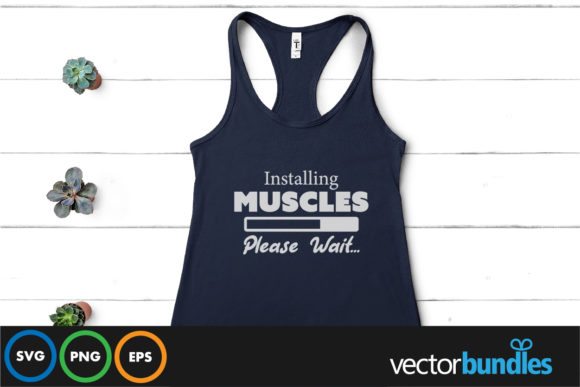
Reviewing Installing Muscles Please Wait .. for Embroidery
As a designer who spends half my life staring at digitized paths and the other half pulling threads out of botched samples, I have learned that not every graphic translates well to fabric. When I first encountered Installing Muscles Please Wait .., my initial reaction was one of amused recognition. It is a clever play on the classic "loading" screen trope, mixed with fitness or self-improvement humor. But humor alone does not make a good embroidery project. The real question is whether this design holds up under the needle, or if it falls apart when you try to stitch it onto a curved surface like a cap or a textured fabric like a towel.
In this review, I am looking at Installing Muscles Please Wait .. not just as a digital image, but as a potential product for your craft business. Whether you are an Etsy seller looking for your next best-seller or a hobbyist making personalized gifts, understanding how this design behaves in real-world applications is crucial before you commit to stitching it on client apparel.
First Impressions and Visual Personality
The mood of Installing Muscles Please Wait .. is playful, modern, and slightly tech-savvy. It appeals to a demographic that enjoys gym culture, gaming references, or just general millennial and Gen Z humor. Visually, the design likely relies on a combination of bold typography and perhaps a graphical element representing a loading bar or a muscle icon. For embroidery, this mix of text and graphics requires careful attention to detail. If the font is too thin, it will vanish on certain fabrics. If the graphical elements are too dense, they will create a stiff, cardboard-like patch on soft garments.
From a Crafts and Graphics perspective, the design feels versatile. It does not scream "seasonal," which means it has evergreen potential. You are not limited to selling this only during New Year’s resolution season. It can work year-round for gym goers, personal trainers, or anyone who appreciates a witty statement on their gear.
Real-World Application: The Sweatshirt Test
To truly evaluate Installing Muscles Please Wait .., I imagined placing it on a mid-weight cotton blend sweatshirt. This is a common item for custom apparel orders. The chest area provides a flat, stable canvas, which is ideal for designs that include text. In this scenario, the design acts as a focal point. The contrast between the thread colors and the fabric becomes the most critical decision. If you choose a heather gray sweatshirt, you need high-contrast thread colors to ensure the "Installing" text and the "Please Wait" message remain legible from a distance.
I also considered this design for a tote bag. Tote bags are often made from canvas, which has a visible weave. A design like this needs sufficient stitch density to cover the fabric texture without sinking into the weave. If the digitizing is too light, the background fabric will show through the letters, ruining the clean look of the "loading" aesthetic. For a tote bag design, I would recommend using a cut-away stabilizer to provide long-term support, especially since tote bags carry weight and undergo stress.
Navigating Fabric and Hoop Constraints
One of the biggest challenges with text-heavy or detailed graphic designs is scaling. If you plan to use Installing Muscles Please Wait .. on a baby onesie or a small embroidered patch, you must check the minimum size requirements. Tiny lettering can easily become illegible if scaled down too far. The dots in the ellipsis or the fine lines of a loading bar might merge together, creating a blob rather than a clear message. Always test the design on scrap fabric at your intended size before stitching on the final product.
Curved surfaces present another hurdle. Placing this design on a cap requires careful positioning. The front panel of a cap is narrow and curved. If the design is too wide, it will wrap around the sides, distorting the text and making it hard to read. For caps, you might need to stack the text vertically or ensure the horizontal width fits within the standard 2.5-inch to 3-inch usable area. Additionally, caps require stiff stabilizers to prevent puckering, especially if the design uses fill stitches heavily.
Dark fabrics pose a color challenge. If you are stitching on black leggings or a navy hoodie, you cannot rely on subtle shading. You need bright, vibrant thread colors to make the design pop. This is where checking your thread color chart against the design preview is essential. Do not assume the default colors in the software will look good on every fabric. Customizing the thread palette is part of providing a professional finished product.
Technical Considerations for Digitizing and Stitching
Since Installing Muscles Please Wait .. comes as a zip file containing SVG, PNG transparent, and EPS formats, it is important to note what this means for embroidery. These are primarily vector and raster graphic formats, commonly used for cutting machines like Cricut Design Space or Silhouette, and for print-on-demand services. They are not native machine embroidery files like PES, DST, or JEF. If you are an embroiderer, you will need to use digitizing software to convert these graphics into a stitch file, or ensure you have access to a pre-digitized version if one is provided separately. If you are digitizing it yourself, pay close attention to stitch types. Use satin stitches for borders and smaller text to keep the profile low, and fill stitches for larger graphical elements, ensuring you apply proper underlay to anchor the threads.
Stitch density is another factor. Over-digitizing can lead to thread breaks and fabric distortion. Under-digitizing leads to poor coverage. For a design with a humorous, clean aesthetic, you want crisp edges. This means optimizing your pull compensation and ensuring your jump stitches are minimized to reduce trimming time and potential loose threads on the back of the garment.
Commercial Viability and Brand Consistency
For small shop owners and Etsy sellers, Installing Muscles Please Wait .. offers a niche appeal. It fits well in shops that focus on fitness motivation, geek culture, or humorous everyday wear. It adds personality to your inventory without being overly controversial. However, always verify the licensing terms. Just because you have the SVG and PNG files does not automatically grant you the right to sell physical embroidered items commercially. Check the creator’s terms of use. Some designers allow commercial use for physical products but restrict the resale of the digital files themselves.
When marketing this item, use high-quality printable mockups to show customers how it looks on different products. Show it on a gym bag, a t-shirt, and a water bottle sleeve. This helps buyers visualize the utility and humor of the design. A well-presented listing with clear images of the stitched result builds trust and increases conversion rates.
Final Verdict and Designer Notes
In conclusion, Installing Muscles Please Wait .. is a charming design with strong potential for personalized gifts and custom apparel. Its success depends entirely on execution. Here are my final practical notes for anyone planning to use this design:
- Test on Scrap: Always stitch a sample on the same fabric type you intend to sell.
- Check Stabilizer: Use the right stabilizer for the fabric weight to prevent puckering.
- Verify Formats: Remember that SVG, PNG, and EPS are graphic files. Ensure you have the correct embroidery file format or digitize it properly.
- Contrast is Key: Choose thread colors that stand out against the fabric background.
- Mind the Scale: Ensure text remains legible at smaller sizes, especially for baby items or patches.
If you approach this design with careful preparation and attention to technical details, it can be a standout addition to your product line. It is fun, relatable, and visually engaging, provided you respect the limitations of the embroidery medium.